MVP Development Cost in 2026: What It Takes to Build Your First Version
What does it really cost to build an MVP? Here's how scope, team, timeline and technology decide the price, with a simple way to estimate your own budget before you talk to developers.
If you're planning a startup or a new SaaS product, one of the first questions is: what will MVP development cost? The honest answer is that it depends far more on your decisions than on any price list. Two founders can ask for "an MVP" and receive quotes that are ten times apart, simply because they described very different products.
This guide explains what an MVP should include, what drives the cost, and a simple formula you can use to estimate your own budget before speaking to any development team.
What an MVP is (and what it isn't)
A minimum viable product is the smallest version of your product that lets real users get real value, so you can learn whether the idea works. It is not a cheap version of the final product, and it is not a demo that only works in a pitch.
A good MVP:
- Solves one core problem for one clear type of user
- Includes only the features needed for that job, done properly
- Is stable and secure enough for real people to use
- Collects the data you need to decide what to build next
Everything else, such as advanced settings, extra roles, integrations and admin luxuries, waits until users prove they want it.
The main factors that decide MVP development cost
1. Scope and number of features
Scope is the biggest cost driver by far. Every screen, user role, rule and edge case needs design, development and testing. Cutting a "nice to have" feature often saves more money than negotiating the hourly rate.
2. Platform
A web app is usually the most economical way to launch. Native iOS and Android apps double some of the work. Cross-platform frameworks like Flutter or React Native can reduce that, but a responsive web app is still the cheapest way to test most B2B and SaaS ideas.
3. Design depth
A clean interface built on a proven design system costs less than fully custom branding, illustrations and animations. For an MVP, clarity matters more than decoration. Good UX design still pays for itself, because confusing products don't get honest feedback.
4. Integrations
Payments, email, maps, calendars, CRMs, AI models and third-party APIs each add setup, error handling and testing. Some are quick; others, such as complex two-way syncs, are projects of their own.
5. Team location and seniority
Hourly rates vary widely between regions and between freelancers, small studios and large agencies. Teams in South Asia, including Pakistan, often cost a fraction of North American or Western European rates. The cheapest option is rarely the cheapest outcome, though: a senior developer who builds it right once can cost less than a junior team that builds it twice.
6. Timeline
A tight deadline means more people working in parallel and more coordination. If your launch date is flexible, a smaller team over a slightly longer period is usually more cost-effective.
7. Compliance and security needs
Products that handle health records, payments or personal data need stronger security, audit trails and sometimes legal review. Build this in from the start; adding it later is far more expensive.
A simple formula to estimate your MVP budget
You can make a realistic first estimate yourself:
- List the screens and features your first users truly need.
- Estimate hours per feature with your developer (or ask for a range).
- Add design, testing and project management, often a meaningful share on top of pure coding time.
- Add a buffer for unknowns, because every project discovers some.
- Multiply total hours by the team's blended hourly rate.
Estimated cost = (feature hours + design + QA + project management) × hourly rate + bufferFor example, and purely as an illustration, a small team of three people working for ten weeks is roughly 1,200 hours. Multiply that by the rate of the team you are considering and you have a ballpark. Your real quote should break this down feature by feature.
Tip: Ask every vendor for a feature-by-feature estimate, not a single number. It shows you exactly where the money goes and what you can cut.
Typical MVP types, from lightest to heaviest
- Clickable prototype: designed screens with no real backend. Useful to test interest and raise early funding, and usually the cheapest step.
- No-code or low-code MVP: built on tools like Bubble or Webflow plus automation tools. Fast and affordable for simple workflows, with limits on scale and customisation.
- Custom web MVP: a real application with user accounts, a database and a core workflow. The most common choice for SaaS.
- Web plus mobile MVP: adds app store publishing, device testing and more maintenance.
- Complex MVP: marketplaces, real-time features, heavy integrations or regulated data. These take the most time and budget.
The MVP development process
A typical process looks like this:
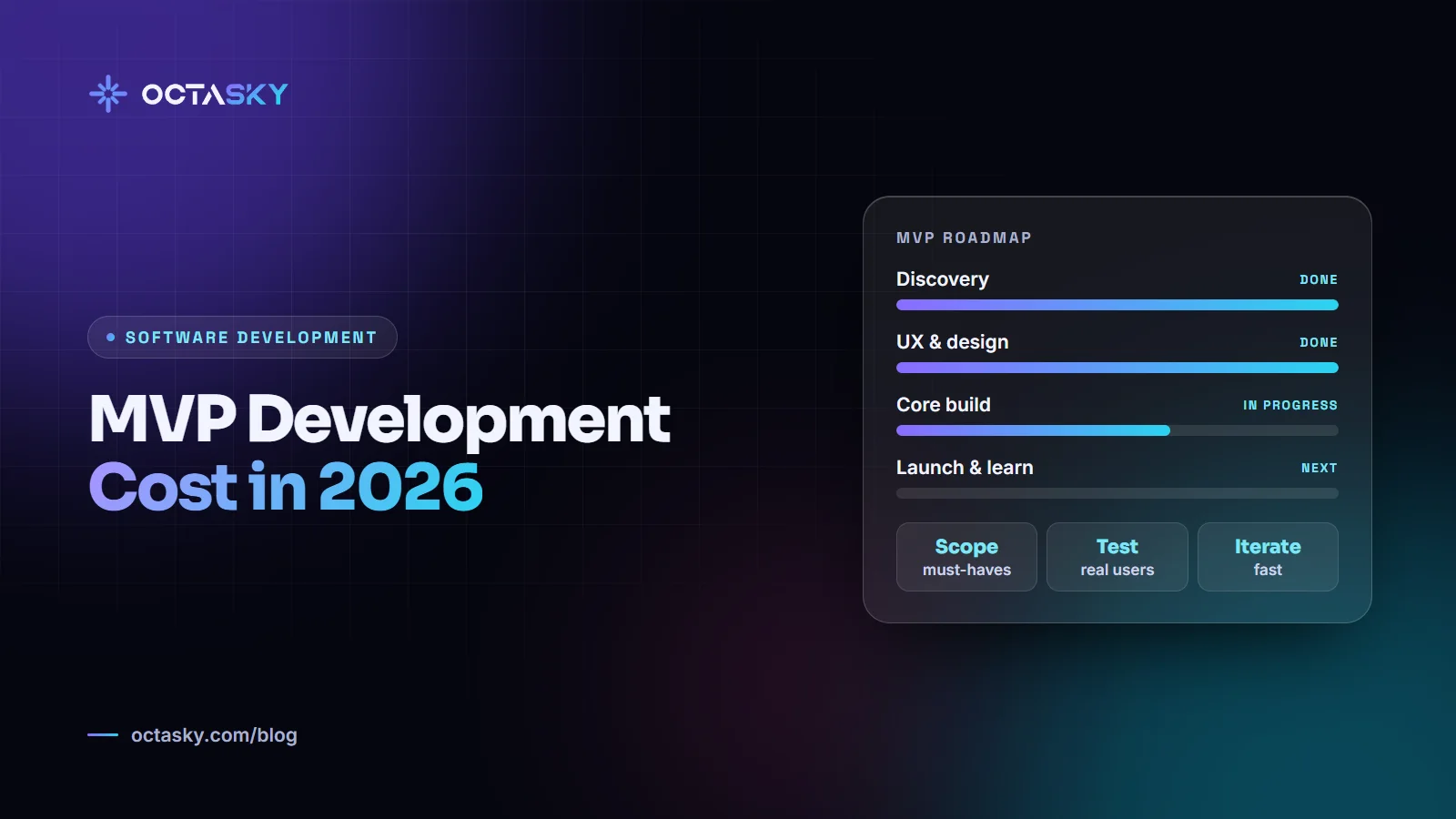
- Discovery: goals, users, competitors, must-have features and success metrics.
- UX and design: user flows, wireframes and clickable designs you approve before coding.
- Core build: development in short sprints, with a working demo at the end of each.
- Testing: functional testing, devices and browsers, and basic security checks.
- Launch and learn: release to early users, measure, collect feedback and plan the next version.
Our guide to custom software vs off-the-shelf tools can also help you decide whether you need custom development at all.
Hidden costs to plan for
The build is only part of the budget. Also plan for:
- Hosting, domain, email and monitoring tools
- Third-party services billed per use, such as SMS, maps or AI APIs
- App store developer accounts if you launch mobile apps
- Maintenance, bug fixes and security updates after launch
- Improvements based on what early users tell you
How to keep MVP development cost under control
- Write down the one problem your MVP solves and remove anything that doesn't serve it.
- Launch on web first unless your idea truly needs a native app.
- Use proven tools and services (authentication, payments, email) instead of building them from scratch.
- Agree on milestones tied to working software, not just dates.
- Make sure you own the code, the cloud accounts and the domain from day one.
FAQ
How long does it take to build an MVP?
Many MVPs take somewhere between a few weeks and a few months, depending on scope, platform and team size. A clickable prototype can be ready much sooner than a working product.
Is it cheaper to hire freelancers or an agency for an MVP?
Freelancers can cost less per hour, but you take on the project management and the risk of gaps in skills. A software house provides design, development, testing and project management together. Compare the total cost and the risk, not just the hourly rate.
Can I build an MVP with no-code tools?
Yes, for many simple products. No-code is a good way to validate demand quickly. If the idea works and you need more control, performance or custom logic, you can rebuild with custom code later.
Should I build a mobile app or a web app first?
For most B2B and SaaS ideas, a responsive web app is faster and cheaper to launch and update. Build native apps when your users need features like offline use, push notifications or device hardware.
The bottom line
MVP development cost is something you can shape. A focused scope, a clear process and the right team matter more than any average figure online. Start with the one problem you want to solve, estimate it feature by feature, and keep everything else for version two.
OCTASKY's development team in Multan builds web apps and SaaS MVPs for founders and businesses. Send us your feature list and we'll reply with a clear, feature-by-feature estimate. If you're still choosing a partner, read our guide on how to choose a software house in Pakistan.
Need help with this?
OCTASKY's team of 15+ designers, developers, editors and marketers can take it off your plate. Tell us about your project and we'll reply with ideas and a clear quote.
Chat on WhatsApp