Software House in Pakistan: How to Choose the Best One (12 Questions)
Looking for a software house in Pakistan? Where to find credible lists, how to judge which one is best for your project, and 12 questions to ask before you sign.
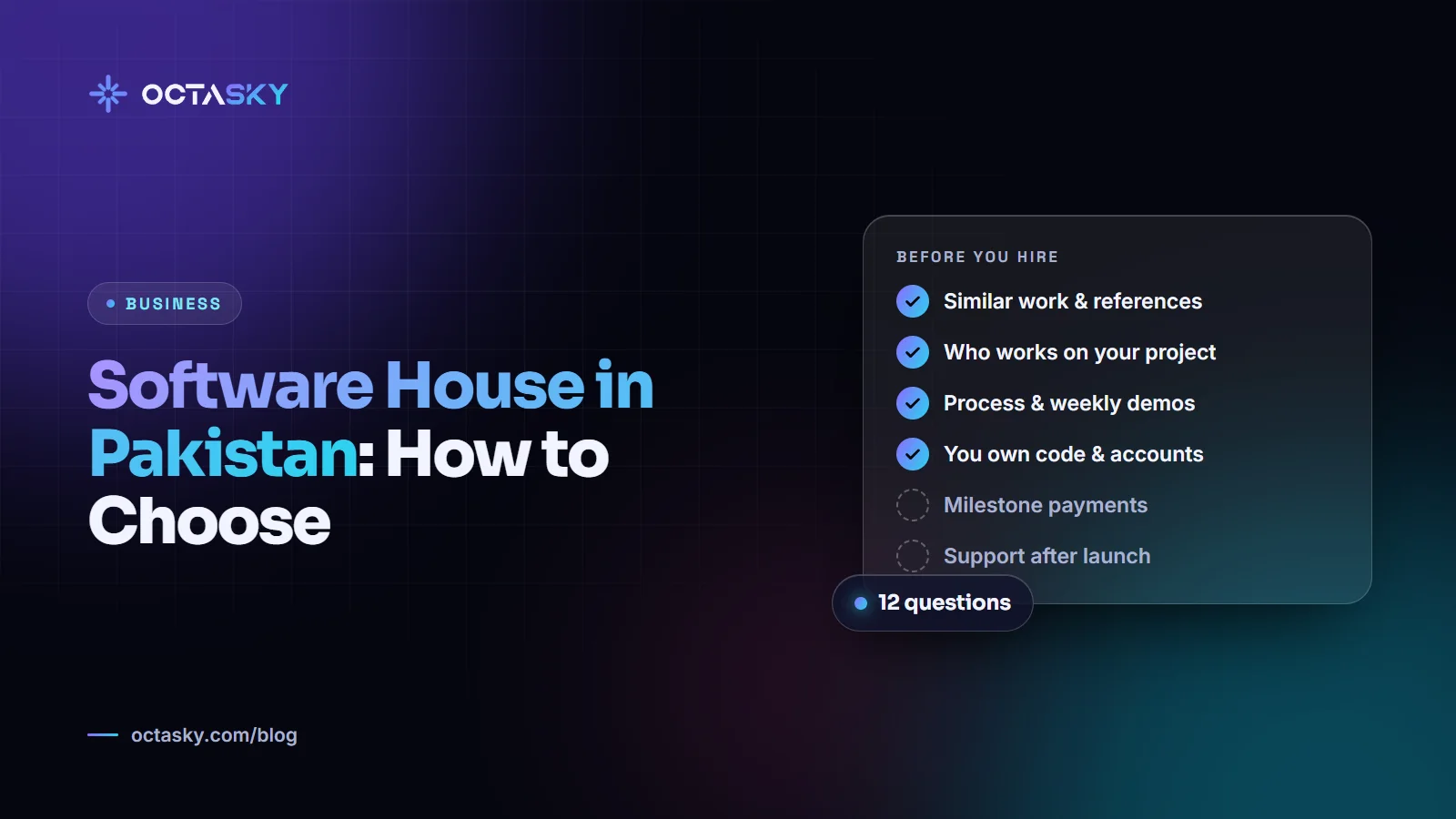
If you're searching for a software house in Pakistan, you'll find no shortage of options, and plenty of lists claiming to name the best. Pakistan has become a popular destination for software development, design and digital services, with a large pool of developers and designers, strong business English and software companies in cities across the country.
That variety is an advantage, but quality ranges widely. The right partner will feel like an extension of your team; the wrong one can cost you months. Whether you're a local business or an overseas client, this guide explains where to find credible lists, how to judge "best" for your project and the 12 questions to ask first.
Pakistan's IT industry at a glance
A few verified facts help set the scene:
- Exports are growing. Pakistan's IT and IT-enabled services exports reached about $4.6 billion in the 2025-26 fiscal year, according to State Bank of Pakistan data reported in July 2026, up from about $3.8 billion the year before.
- There's official support. The Pakistan Software Export Board (PSEB), a government company set up in 1995, promotes the IT industry at home and abroad. P@SHA, the Pakistan Software Houses Association, represents IT and IT-enabled services companies.
- Time zone: Pakistan Standard Time is UTC+5, which gives a comfortable overlap with the Gulf and Europe and a few shared hours with North America.
Software houses in Lahore, Karachi, Islamabad and Multan
Lahore, Karachi and Islamabad (with Rawalpindi) are generally seen as the country's main tech hubs. Lahore is home to Arfa Software Technology Park, run by the Punjab government. Karachi is the country's largest city and commercial centre, and Islamabad is the federal capital.
Software houses also operate in many other cities, including Multan, Faisalabad and Peshawar. For most projects, the team matters far more than the city.
How many software houses are there in Pakistan?
There's no single reliable number. Registration with PSEB isn't mandatory for most IT companies, and the counts published in recent reports differ widely depending on the source and whether they include only active registrations. Freelancers and small studios that never register add to the gap. If you see a precise figure, check where it came from and when.
Where to find a list of software houses in Pakistan
Many "top 10 software companies in Pakistan" articles are written by companies that rank themselves first, so use them as leads at most. More credible places to find software and IT companies in Pakistan:
- PSEB's Tech Destination portal, which has a searchable directory of IT companies, BPOs and freelancers, filterable by expertise and location.
- P@SHA's members directory on the association's website.
- Review platforms such as Clutch and GoodFirms, where you can read client reviews and filter by service and location. Check how many reviews are verified and how recent they are.
- Freelance marketplaces like Upwork and Fiverr, where agency profiles show job history and client feedback.
- LinkedIn, to see team size, real employees and how long people stay.
You can also confirm a company's legal registration with the Securities and Exchange Commission of Pakistan (SECP).
What "best software house in Pakistan" really means
There's no best software house in Pakistan for every project. The best one for you is the team that has built something similar, communicates clearly in your time zone, protects your ownership and is still around to support it after launch. A large IT company may suit an enterprise system with strict compliance needs, while a smaller software house may give a startup more senior attention for the same budget. Judge by evidence, not by rankings.
Before you contact anyone
Write a short brief. It makes every conversation more useful and every quote easier to compare:
- What problem are you solving, and for whom?
- Must-have features and nice-to-haves
- Systems it needs to connect with
- Your timeline and budget range
- Who on your side will make decisions and give feedback
The 12 questions to ask a software house
1. Can I see similar work, and speak to a past client?
A portfolio shows what they can make. A conversation with a past client shows what they're like to work with. Ask for projects close to yours in type and size, and look at live products where possible, not just screenshots.
2. Who will actually work on my project?
Ask for the team structure: project manager, designers, developers and QA. Find out their experience levels, and whether the work is done in-house or passed to subcontractors.
3. What is your development process?
Good answers mention discovery, design approval, development in short cycles (sprints), regular demos, testing and a clear launch plan. Vague answers like "we'll start coding right away" are a warning sign.
4. How and when will we communicate?
Agree on tools (Slack, WhatsApp, email, Jira or Trello), meeting frequency and response times, and ask how they handle the time difference.
5. How do you estimate, and what's included?
Understand whether the quote is fixed-price or time-and-materials, what assumptions it's based on, and how changes are handled. Ask specifically what is not included, such as hosting, third-party licences, content or post-launch support.
6. Who owns the code, designs and accounts?
You should. The contract should assign intellectual property to you after payment, and code repositories, domains, hosting and app store accounts should be in your name, or transferred to you at handover.
7. How are payments structured?
Milestone payments tied to working deliverables protect both sides. Be careful with requests for full payment upfront. A small deposit followed by milestone payments is common and fair.
8. How do you test?
Ask about manual QA, automated tests, testing on real devices and browsers, and how bugs are reported and tracked, including bugs found after launch.
9. How do you handle security and data?
Look for NDAs, limited access to production systems, secure storage of passwords and keys, regular backups and awareness of data protection rules that apply to your users.
10. What happens after launch?
Ask about a warranty period for bug fixes, maintenance plans, response times for urgent issues and the cost of ongoing improvements.
11. Is the company properly registered?
Established software houses can usually show SECP company registration, tax registration and, for IT exporters, PSEB registration. Independent profiles with verified reviews add another layer of confidence.
12. What will you need from me?
Good partners are clear about your responsibilities too: content, brand assets, timely feedback and approvals. Projects slow down most often while waiting on the client.
Red flags to watch for
- A detailed quote before they've asked you any real questions
- A price or timeline that seems too good to be true
- No written contract, or a scope that stays vague
- Refusal to show any work in progress until the end
- A salesperson as your only contact, with no access to the actual team
- A portfolio that looks like templates, or reviews that all sound the same
Green flags
- They ask "why?" and challenge assumptions politely
- A written scope with milestones and acceptance criteria
- Regular demos of working software, not just status updates
- Honesty about risks and trade-offs, even when it costs them the easy yes
Start with a small paid pilot
If you're unsure, begin with a short paid engagement, such as a discovery phase, a design sprint or one small feature. A week or two of real collaboration tells you more than any sales call.
Choose a partner the way you'd hire a key employee: check their work, talk to their references and start with a trial.
An honest look at outsourcing to Pakistan
The advantages are real: competitive pricing, skilled talent, a large digital services ecosystem and convenient time-zone overlap for many regions. There are also practical things to plan for, such as public holidays like the two Eids, and occasional power or internet disruptions. Strong vendors have backup power and connectivity in place, so ask about it.
FAQ
Which is the best software house in Pakistan?
It depends on your project. The best choice is a team with relevant, live work, a clear process, written ownership terms and good references from clients like you. Be cautious with ranked lists, because many are published by the companies they rank.
How many software companies are there in Pakistan?
Figures vary by source. PSEB registration isn't compulsory for most IT firms, and published counts differ widely, so treat any single number with care and check its source and date.
Which city is best for software houses in Pakistan?
Lahore, Karachi and Islamabad have the largest tech ecosystems, but capable software houses also work from cities like Multan and Faisalabad. Choose the team, not the postcode, and confirm they can meet in person if that matters to you. Our guide to choosing a website development company in Multan covers local options.
How much does it cost to hire a software house in Pakistan?
Pricing depends on scope, team seniority and timeline, and Pakistani teams often cost less than North American or Western European ones. Ask for a feature-by-feature estimate; our guide to MVP development cost shows how to build one.
How can I check if a software house in Pakistan is registered?
Ask for its SECP incorporation details and, if it exports services, its PSEB registration certificate, then check them against official records. Verified reviews on independent platforms add further confidence.
Ask every question
Not sure whether you need a custom build at all? Read our guide to custom software vs off-the-shelf first.
At OCTASKY, our team works from Multan, Pakistan, and we're always happy to answer every one of these questions before you decide. Whoever you choose, ask them all.
Need help with this?
OCTASKY's team of 15+ designers, developers, editors and marketers can take it off your plate. Tell us about your project and we'll reply with ideas and a clear quote.
Chat on WhatsApp